
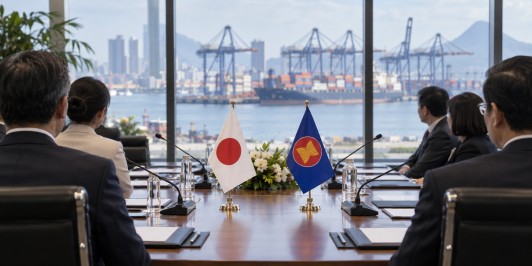
Japan and the Association of Southeast Asian Nations (ASEAN) have agreed to explore expanding their economic partnership to enhance supply-chain resilience, energy security, and the utilization of artificial intelligence. This decision was reached during a meeting of economic ministers held in Manila on September 20.
The focus of the discussions was on updating the existing agreement, which has been in place since 2008, in light of increasing global supply chain risks and the growing influence of AI in economic activities. The two sides also deliberated on ways to ensure stable energy supplies, particularly in response to disruptions affecting key routes in the Middle East.
Japan reiterated its commitment to bolstering oil stockpiles in ASEAN countries, a move aimed at enhancing regional energy security. Economic ministers emphasized the necessity of closer cooperation amidst ongoing geopolitical tensions and uncertainties in global trade.
The original Japan-ASEAN economic partnership agreement, since its implementation, has expanded to include trade in services and investment. As of 2025, Japan and ASEAN have engaged in bilateral merchandise trade valued at $245.4 billion, with Japanese investments in ASEAN reaching $9.5 billion.